The 2026 NFL Draft agency leaderboard has an obvious winner: Athletes First.
The Laguna Hills-based agency finished the first round with nine selections, returning to the top of the leaderboard after CAA led the previous two drafts.
Its Athletes First’s first first-round victory in three years and the end of CAA’s two-year win streak.
The better story is what the last decade says about the NFL’s player representation market. The league’s agency business is fragmented. No single firm controls the NFL.
Even the biggest agencies represent only a slice of the player pool, and every draft class is spread across a long list of firms, agents, and boutique practices.
But the top of the first-round leaderboard has not been random.
Since 2016, the agency with the most first-round NFL Draft picks has been either CAA or Athletes First. CAA led the first-round agency race from 2016 through 2019. Athletes First took over from 2020 through 2023. CAA came back in 2024 and 2025. Then Athletes First reclaimed the top spot in 2026.
That makes the 2026 draft more than a one-year leaderboard.
It is the latest swing in a much longer fight over who owns the most visible stage in football representation.
And the fight is not perfectly even. Over the longer period, CAA still owns the stronger résumé. From 2017 through 2026, CAA had 71 first-round picks. Athletes First had 58. CAA also posted the two biggest single-agency first-round performances in the period: 11 picks in 2018 and a record 12 in 2024.
The point is that CAA built the benchmark — and Athletes First has become the one agency capable of repeatedly interrupting it.
The NFL Draft Has Its Own Agency Scoreboard
There is a reason first-round picks matter so much in the agency business.
Every agency can talk about relationships, trust, process, marketing, training, contract expertise, and long-term career management. But draft night gives the market a visible scoreboard.
Who had the most first-rounders?
Who represented the players teams valued most?
Who had the class that prospects, parents, trainers, college coaches, general managers, brands, and media could all see?
First-round picks are not just clients. They are proof points. They carry rookie contract value, league-wide visibility, endorsement potential, media attention, and future extension upside. They become recruiting tools for the next class.
That is why CAA’s long-term first-round résumé matters. It is not just a data point. It is a business asset.
And CAA did not build that asset by accident.
CAA Did Not Enter American Football Quietly
CAA’s football story begins with a power move
In April 2006, CAA hired Tom Condon and Ken Kremer away from IMG. At the time, Condon had resigned as IMG’s football president and was already one of the most influential agents in the sport. Condon and Kremer had worked together for 17 years, represented 35 NFL first-round draft picks, and had a roster that included stars such as Peyton Manning.
That move effectively gave CAA a football division overnight.
CAA was not slowly building from the bottom of the NFL representation market. It was importing one of the sport’s most valuable agent practices into a Hollywood talent agency that wanted sports to become its next growth engine.
Before CAA, Condon and Kremer had already helped make IMG Football one of the dominant forces in draft representation. Their arrival gave CAA instant credibility with elite players, quarterbacks, teams, and league decision-makers.
The timing mattered. By the mid-2000s, sports representation was changing. The old agent model — negotiate the contract, maybe handle endorsements — was being stretched into something larger. Top athletes were becoming media properties, business platforms, endorsement vehicles, philanthropists, investors, and future broadcasters.
CAA’s advantage was that it already understood the machinery around talent. It represented actors, directors, writers, musicians, broadcasters, and media personalities. Football gave the agency a new kind of client, but the agency’s pitch was familiar: we do not just negotiate your deal; we manage the business of your career.
CAA’s own football division still frames the offering that way today, describing services around draft preparation, training, media preparation, contract negotiation, marketing, endorsements, broadcasting, philanthropy, and opportunities across CAA’s film, television, broadcasting, music, and digital businesses.
The Roll-Up Strategy
CAA did not stop with Condon and Kremer.
Only months after the IMG hires, CAA added another major football practice by bringing in Ben Dogra and Jim Steiner from SFX Football. Sports Agent Blog later described the deal as CAA buying SFX Football for roughly $30 million, with Dogra and Steiner bringing 57 NFL clients and eight employees. The move put Dogra and Condon — two of the most powerful football agents of the era — under the same roof.
That is the first key to understanding CAA’s football dominance: it was built as a roll-up.
CAA was not just signing players. It was consolidating agent power.
Condon and Kremer brought the IMG pipeline. Dogra and Steiner brought the SFX pipeline. Together, they formed a football operation with star agents, premium players, draft history, and a broader entertainment platform behind them.
By 2008, the combined CAA Football operation represented about 130 players and noted that Condon and Dogra had represented four of the previous five first-overall picks and 48 first-round picks since 2001.
That is the foundation of the CAA story. The agency’s later draft dominance was not a sudden hot streak. It was the output of a deliberate consolidation strategy.
Capital Gave CAA More Firepower
In 2010, CAA added another layer of scale when TPG Capital took a non-controlling 35% stake in the agency. As part of the deal, CAA and TPG committed to a $500 million pledge fund designed to provide capital for future investments.
That did not just matter for Hollywood. It mattered for sports.
CAA had already entered sports in 2006. By 2010, the firm was building a full-service sports platform. TPG’s investment gave CAA more financial flexibility to keep expanding — through acquisitions, new divisions, international growth, and deeper client services.
In football, that mattered because NFL representation is still a relationship business, but it is no longer just a relationship business. The modern elite player needs pre-draft training, media prep, brand strategy, contract negotiation, endorsements, financial guidance, philanthropy, and post-career planning. The bigger the platform, the easier it is to make that pitch.
CAA’s pitch became scale with access.
Jimmy Sexton Expanded The Football Power Base
CAA’s next major football move came in 2011, when Jimmy Sexton joined from SportsTrust Advisors.
Sexton was not just another football agent. He represented both players and coaches, giving CAA a deeper foothold in the college football ecosystem. Sports Agent Blog wrote at the time that Sexton’s move would improve an already strong CAA Football division, noting that Sexton represented both players and coaches.
That matters because the NFL Draft does not begin at the draft.
It begins years earlier, inside college football. Relationships with coaches, programs, trainers, families, and staffers can shape who gets trusted, who gets recommended, and which agents are seen as credible when a prospect is preparing to turn professional.
Sexton gave CAA another layer of influence around the machinery that produces future draft picks.
CAA was no longer just a football player representation shop. It was becoming a football power center.
Todd France Strengthened CAA’s Dominance
In 2015, CAA added another major football agent when it acquired Todd France’s Five Star Athlete Management.
At the time, France’s firm represented about 50 NFL players, and the acquisition added another elite agent practice to CAA’s already powerful football division.
The pattern was familiar: CAA saw a major independent football practice and absorbed it.
Condon and Kremer. Dogra and Steiner. Sexton. France.
Each move added another piece to the same machine.
And the results showed up in the draft.
CAA led the first-round agency race in four straight drafts from 2016 through 2019. It had seven first-round picks in 2016, nine in 2017, 11 in 2018, and six in 2019. In 2018, CAA broke its own record for most first-round picks by a single agency with 11.
That was CAA at full strength.
The agency had built the best first-round résumé in the market by combining elite agent talent, NFL relationships, college football reach, entertainment infrastructure, and acquisition-driven scale.
Then came 2020.
Athletes First Was Built Very Differently
If CAA’s football power was built through consolidation, Athletes First’s rise began with a rupture.
Athletes First was founded in 2001 after David Dunn, Brian Murphy, and Joby Branion left Steinberg, Moorad & Dunn, then one of the most powerful football representation firms in the country. The split immediately turned into one of the most contentious agent battles in the sport. Leigh Steinberg and Jeff Moorad sued Dunn, alleging that he breached his contract and tried to lure away much of SMD’s client base into a new agency, Athletes First.
The legal fight nearly buried the new firm.
In 2002, a federal jury awarded Steinberg’s side $44.6 million after finding that Dunn had conspired to steal away high-profile clients.
That is a very different origin story from CAA’s.
CAA entered football with corporate scale, Hollywood credibility, and a roll-up strategy. Athletes First started as a breakaway firm fighting for survival.
But it survived.
And that survival became part of its identity.
Athletes First positioned itself as a football-first, relationship-driven agency. Its own company description says it has represented elite players, coaches, personnel, and broadcasters since 2001 and describes its culture around being both powerful and personal.
Quarterbacks Gave Athletes First Credibility
After the early legal fight, Athletes First still had to prove it could compete for elite football clients.
It did that by building credibility in one of the most valuable areas of the NFL agency business: quarterbacks.
The agency represented high-profile quarterbacks early in its history, including Carson Palmer, the No. 1 overall pick in 2003. Over time, the firm became closely associated with top quarterback representation and major offensive talent.
That matters because quarterbacks are the highest-leverage clients in football. They drive the biggest contracts, the most media attention, and the strongest recruiting proof. A firm that can build trust with quarterbacks can build trust with the rest of the market.
Athletes First did not need to become CAA to compete. It needed a different pitch.
Athletes First Got Capital Later
For years, Athletes First was the independent football agency trying to compete with larger platforms.
Then outside capital arrived.
In 2015, Dentsu acquired a 33% stake in Athletes First in a transaction later reported to have valued the agency at $50 million.
That gave Athletes First more firepower at a time when the agency business was moving toward broader client services and more sophisticated off-field opportunities.
Then, in 2023, Mastry Ventures and General Catalyst acquired a majority stake in Athletes First. The deal positioned Athletes First as a football agency representing athletes, coaches, front-office personnel, and broadcasters, and the announcement said the partnership was intended to create new platforms for clients beyond the field.
This is one of the key differences between the two agencies.
CAA entered football with a giant entertainment platform already behind it. Athletes First built itself as an independent football-first agency, then added outside capital later to expand the platform around its clients.
That makes the rivalry more interesting. These were not two identical firms fighting over the same space. They were built through different routes.
CAA was consolidation from above.
Athletes First was survival from below, followed by scale.
The 2020 Inflection Point
The rivalry changed in 2020.
First, the draft board shifted.
Athletes First led all agencies with eight first-round picks in the 2020 NFL Draft, ending CAA’s four-year run as first-round leader. CAA still had six first-rounders, so it was not a collapse. But the streak was over.
Then, a few months later, the agency market shifted too.
In August 2020, Todd France and CAA mutually agreed to part ways. France ranked third among NFL contract advisors by active players signed to Standard Representation Agreements, behind only Drew Rosenhaus and CAA’s Jimmy Sexton, and that his clients included Dak Prescott, Kenny Golladay, Brian Burns, Javon Kinlaw, and Justin Jefferson.
In September 2020, France joined Athletes First, bringing clients including Dak Prescott, Bud Dupree, Aaron Donald, and Fletcher Cox, along with longtime colleagues Jennifer Thatcher and Julie Voelker.
That was the hinge.
Athletes First had already beaten CAA on the 2020 first-round leaderboard before France arrived. So France’s move did not create the initial 2020 draft win.
But it made the challenge bigger.
CAA had built much of its football machine by acquiring elite agents and practices. In 2020, one of the major agents it had added moved in the other direction — to the agency that had just ended CAA’s first-round streak.
That is when the CAA-Athletes First battle became more than a leaderboard.
It became a power transfer story.
Athletes First Kept The Pressure On
After 2020, Athletes First did not fade back into the field.
It led the first-round agency race again in 2021, 2022, and 2023. In 2021, it edged CAA with eight first-rounders. In 2022, it led with five. In 2023, it led again with eight, while CAA finished second with six.
That four-year run mattered because it proved 2020 was not a one-off.
CAA had built the dominant first-round machine of the late 2010s. Athletes First had now built its own run at the top of the draft board.
The pattern had flipped.
From 2016 through 2019, the question was whether anyone could catch CAA.
From 2020 through 2023, the question became whether CAA could reclaim the top spot from Athletes First.
CAA’s Record-Setting Answer
CAA’s answer came in 2024.
CAA did not just reclaim the first-round lead. It set a new single-agency record with 12 first-round picks, surpassing its own previous mark of 11 from 2018.
That year is important because it keeps the story honest.
It would be easy to frame Athletes First’s rise as CAA losing its grip. But 2024 says otherwise. CAA’s machine was still capable of producing the strongest single-year first-round performance in the data.
Then CAA followed it with another win in 2025, finishing with seven first-round picks, just ahead of Athletes First with six.
At that point, CAA had reclaimed the annual crown. It still owned the strongest long-term résumé. And over the 2024-2026 window, CAA still had the highest three-year total in our data, with 22 first-rounders to Athletes First’s 19.
But momentum does not always move in a straight line.
CAA went from 12 first-rounders in 2024, to seven in 2025, to three in 2026. Athletes First moved from four, to six, to nine.
That made 2026 feel like the next swing.
The Tory Dandy Move Added Another Layer
The rivalry became even more direct in 2025.
Athletes First added Tory Dandy as an equity partner. Dandy is the former co-head of football at CAA and at this time Athletes First already had Todd France, David Mulugheta, and Brian Murphy among football’s most prominent agents.
That matters for the same reason the France move mattered.
CAA built the modern football agency benchmark by collecting elite agent talent. Athletes First’s rise became more serious when it began adding major agents with CAA ties.
France moved from CAA to Athletes First in 2020.
Dandy moved from CAA to Athletes First in 2025.
By the time the 2026 draft arrived, Athletes First was not just an independent challenger with a strong culture and a history of quarterback success. It had become a larger platform with outside capital, a deep agent bench, and two high-profile CAA-connected additions.
That does not erase CAA’s lead.
It explains why the rivalry keeps tightening.
What 2026 Really Showed
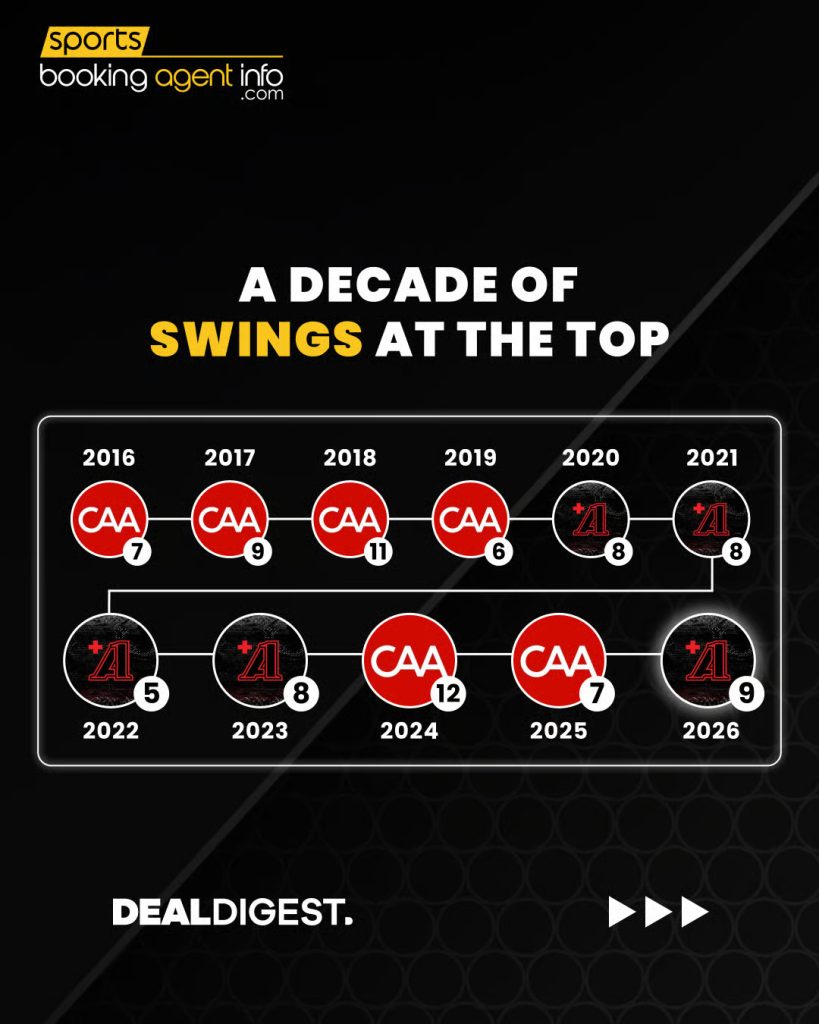
In 2026, Athletes First reclaimed the first-round lead with nine picks.
That gave the agency nearly 28% of the first round. It was a decisive win, and it ended CAA’s two-year run at the top.
But the more interesting takeaway is not simply that Athletes First won.
It is that Athletes First won inside a much longer pattern.
CAA controlled the late 2010s. Athletes First controlled the early 2020s. CAA came back in 2024 and 2025. Athletes First answered in 2026.
That is why this story is not just a 2026 draft recap.
It is a history of how power gets built, defended, lost, and reclaimed in NFL representation.
Excel Sports also added a wrinkle. In 2026, Excel finished second in the first round with four picks. In our three-year view, Excel has moved from two first-rounders in 2024, to three in 2025, to four in 2026. That does not make Excel the new center of the NFL Draft agency market, but it does suggest the layer beneath CAA and Athletes First is getting more competitive.
Still, the main pattern remains unchanged.
The annual first-round crown keeps coming back to CAA or Athletes First.
The Deeper Business Story
The NFL agency market is crowded. Athletes First represents around 10% of the league, according to our data. CAA represents around 7%. SportStars, the next closest, is around 6%.
That means even the biggest agencies only represent a slice of the NFL.
But the first-round leaderboard tells a more concentrated story at the top. Not because CAA and Athletes First own the entire round — they do not — but because the race to finish first keeps coming back to them.
That is the distinction.
The league market is fragmented.
The annual first-round winner’s circle is not.
And that is why the history matters. CAA’s dominance was not accidental. It was built through Condon and Kremer, Dogra and Steiner, Sexton, France, capital, platform services, and draft results. Athletes First’s challenge was not accidental either. It was built through a volatile founding, survival, quarterback credibility, internal agent development, outside capital, a coaches-and-executives platform, and major agent additions from CAA itself.
These are two different models of agency power.
CAA built the institutional machine.
Athletes First built the football-first counterweight.
The First-Round Crown Is No Longer a One-Agency Story
The easy 2026 takeaway is that Athletes First won the first round.
The better takeaway is that CAA has built the strongest first-round NFL Draft résumé of the last decade, and Athletes First has become the one agency that keeps forcing the race back open.
That is what makes the 2026 result meaningful.
It was not the beginning of the story.
It was the latest turn in a long-running agency battle.
CAA entered football by importing elite representation infrastructure from IMG. It expanded by adding SFX, Jimmy Sexton, and Todd France. It used capital and platform scale to build the most powerful first-round résumé in the sport. It led the late 2010s, broke the single-agency first-round record in 2018, then broke it again in 2024.
Athletes First began as a breakaway firm in a legal war with Steinberg, Moorad & Dunn. It survived, built quarterback credibility, developed a football-first identity, attracted outside capital, expanded across players, coaches, executives, and broadcasters, then added Todd France and Tory Dandy from CAA’s orbit. It took over the early 2020s and reclaimed the top spot in 2026.
That is the real story behind the 2026 NFL Draft.
Not just who had the most picks.
How the two most important football representation powers of the last decade built their positions — and how the fight for the top of Round 1 keeps swinging between them.
CAA still owns the strongest résumé.
Athletes First owns the latest statement.
And the first-round agency race is still open.